

 or
or  lines to the right of the URL bar at the top of your browser
Lawn & Order: Understanding Campaign Sign Regulations During Election Season
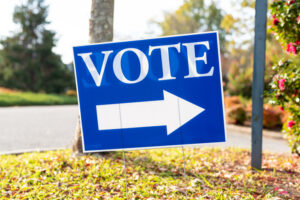 Now that the snow is gone and summer is here, ‘tis the season for yard signs.
Throughout the year, you may see promotional, decorative, and celebratory signs staked in front of homes and businesses throughout your city. As we enter election season, you are likely to notice an increase in political signs supporting candidates for public office or ballot measures.
While many cities regulate signs through city ordinances, state law has special rules that supersede city sign regulations during election season.
Background and context
Signs are one form of constitutionally protected speech under the First Amendment. Cities cannot regulate signs based on the message they display. Cities can, however, adopt content-neutral regulations that restrict the time, place, and manner of speech — when, where, or how signs may be displayed — provided those regulations do not discriminate based on the sign’s content.
The law also applies different standards to commercial and non-commercial signs. Commercial speech, such as signs advertising the sale of a product or service, generally receives less First Amendment protection than non-commercial speech, such as political campaign signs. This is because commercial speech is generally more objective in nature and may be subject to greater regulation to avoid false or misleading messages.
What cities need to know
There are special rules cities should understand when regulating campaign signs during election season. These rules govern issues such as when and where cities can regulate these signs.
When
City ordinances may generally regulate the location, size, and number of signs through content-neutral time, place, and manner restrictions. However, those regulations are limited during election season, which runs from 46 days before the state general primary (Friday, June 26, 2026) through 10 days after the state general election (Friday, November 13, 2026).
During this period, Minnesota law requires cities to allow non-commercial signs of any size and number. This law does not address sign location, so reasonable, content-neutral regulations on sign location still apply during election season (e.g. city sign regulations prohibiting signs from obstructing the city right-of-way).
It is also important to note that cities cannot require campaign signs to be removed after election season. Doing so would be considered a content-based regulation. Campaign signs that meet a city’s location, size, and number regulations can remain displayed even after election season ends.
Where
Cities should also be aware of laws regarding the placement of signs near voting locations.
Minnesota law prohibits campaign signs within 100 feet of the building where absentee voting takes place during the absentee voting period. Additionally, on Election Day, campaign signs are prohibited within 100 feet of any building that houses a polling place and anywhere on the public property where a polling place is located.
Key takeaways
Remember that city sign ordinances must be content-neutral, meaning they cannot prohibit or permit certain signs based on their content or the message they convey.
When evaluating whether a sign regulation is content-neutral, ask two questions:
- Does the regulation refer to the content, language, or message displayed on the sign?
- Was the regulation adopted because of agreement or disagreement with the message the sign conveys?
If the answer to either question is yes, the regulation is likely content-based and may violate the First Amendment.
Finally, remember that state law creates important exceptions to these general rules for city sign regulations during election season. Understanding these requirements can help cities protect free speech while ensuring their sign ordinances remain legally compliant.