

 or
 lines to the right of the URL bar at the top of your browser

Eagan Art House Rebuilt for the Future
By Deborah Lynn Blumberg
For years, Eagan residents interested in the arts enjoyed drawing, painting, and other classes at the Eagan Art House, a 1,200-square-foot 1960s rambler-style building south of downtown. By 2018, however, it was clear the building sorely needed a refresh, including more space for the community to create and connect.
Art students and teaching artists wanted larger, more up-to-date learning spaces and expanded class offerings. The City of Eagan saw an opportunity to make the facility more sustainable and accessible, in line with its strategic priorities.
“A 1,200-square-foot rambler house just wasn’t enough for a fully functioning art space,” said Eagan Parks and Recreation Director Andrew Pimental. The facility was designed for a family, not for the thousands of community members who used it each year. That meant doorways, hallways, and entrances could be challenging to navigate.
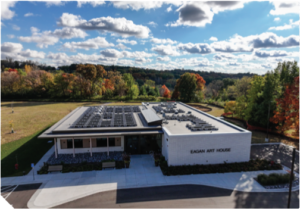
Ultimately, the city transformed the Eagan Art House into a new, 10,000-square-foot, accessible, stateof- the-art facility. The center includes sustainable building and operations features, has led to new jobs and expanded programming, and can accommodate more artists and would-be artists than ever before.
The initiative supports the city’s goal of improving total municipal building energy efficiency by 7.5% for electricity and 12.5% for natural gas by 2035. The City of Eagan won a 2026 Sustainable City Award from the League of Minnesota Cities for its Eagan Art House Rebuild project.
Engaging the community in planning
Plans for a new art house began in 2018, when the city hired an outside consultant to conduct a preliminary study on updating a series of recreational facilities: its art house, community center, water park, and civic arena, where the city wanted to install a covered outdoor ice-skating rink.
The municipality of nearly 70,000 hit pause on planning when the COVID-19 pandemic struck. The city made good use of the extra time, Pimental said. “The pandemic allowed us to get our sustainability program together.”
City leaders could take their time researching sustainable features and determining which would work best. Leaders were especially interested in solar power and geothermal heating and cooling.
Critical to the planning process for the art center, Pimental added, was intentional community engagement on the heels of the pandemic. City leaders met often with stakeholders, including local senior groups, and solicited resident feedback at community events, through surveys, and on social media to help ensure the final design reflected community values.
“We didn’t want to build a facility that was too small, and then five years from now have to figure out how to make it bigger,” he said. “We also didn’t want to create a monstrosity that put a financial burden on the city by being too big.” The engagement helped Eagan leaders settle on a size that was just right.
Funding for the $10 million art house came primarily from general obligation bonds. Eagan also invested $1.65 million from its sustainability fund, which is financed by pass-through payments from energy companies.
Sustainable building features
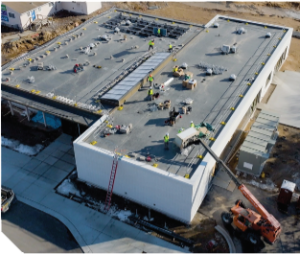
The city broke ground on the art center in May 2024, and it opened to the public in June 2025. Facilities like the Eagan Art House are typically energy-intensive and expensive to operate. The new center is Eagan’s first fossil fuel-free building, relying on solar panels and a geothermal system for heating and cooling. These features were not required by city policy but were an intentional choice in support of climate action and sustainability.
In 2025, Eagan adopted its first Climate Action Plan to reduce community- wide greenhouse gas emissions by 55% by 2035 and achieve net-zero emissions by 2050.
“One of the things we’re most proud of is that the center runs on 100% renewable energy and it’s a fully electric facility,” said Eagan Sustainability Manager Gillian Catano.
The art house has the largest on-site solar array on a city-owned building roof in Eagan. Its 128-panel array produces nearly 60 kilowatts. The facility also includes a geothermal heating and cooling system composed of 40 wells, which efficiently heat and cool the building using the earth’s natural temperature.
“Other city buildings have geothermal systems too, but this is the first time we’ve been able to combine geothermal with solar power at the same site,” Catano explained. “That’s what’s exciting about this facility.”
By integrating on-site solar with geothermal heating and cooling, the project significantly reduced long-term energy demand and reliance on external energy sources. Estimated monthly energy savings exceed $10,000. This approach not only improves energy efficiency, but also helps stabilize operating costs over time.
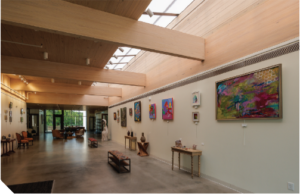
For additional electricity, the city purchases renewable energy credits from its electric provider in the form of wind energy. Eagan also designed the building with daylighting in mind, which is the architectural practice of intentionally placing windows and skylights to bring natural sunlight into a structure. A skylight in the lobby and solar tubes in studio spaces disperse light throughout the rooms.
“Sometimes in the facility you don’t even realize the lights aren’t on,” Catano said.
Meanwhile, city leaders considered the full life cycle of the building during construction, including how materials were extracted and its eventual decommissioning.
“The wood structure lowers the life cycle carbon emissions of the building,” Catano said.
More space to create
The new art facility is open to the public seven days a week and features brandnew pottery studios and wheels, a space for making raku pottery (a traditional form of Japanese pottery), and more classrooms for a variety of programs and activities.
Some 4,600 registered participants have enjoyed the center, compared with 2,800 at the former facility, and 518 activities have been offered, up from 300. The new center has also hosted 62 birthday celebrations, 25 private workshops and field trips, and 15 free community workshops and events, compared with six previously. Artists have used about 27,100 pounds of clay at the new center.
“I think residents were flabbergasted that a space of this size is dedicated just to the arts,” said Tanya Mozingo, Eagan’s recreation superintendent.
The expanded programming means that “you don’t have to feel like you’re an artist to partake,” Mozingo added. She said the city was intentional throughout the design process to make sure the facility was welcoming and inclusive for all.
The added space also allows for an exhibit area for emerging artists. This summer, more than 900 campers enjoyed art camp in the building. In past summers, campers were spread out across other city buildings. “It was a tight can of sardines at the old building,” Mozingo said.
Lessons for other cities
To Minnesota municipal leaders mulling over similar sustainability-focused projects, Pimental said: “My message is, don’t be afraid — people will support this. Proceed with a strong engagement process and you’ll be surprised by how much teamwork you will have.”
And while other cities may not have a sustainability fund like Eagan’s, Catano noted that plenty of other resources and funding sources are available through the state. For example, Minnesota passed legislation in 2023 creating its own green bank — the Minnesota Climate Innovation Finance Authority (MnCIFA) — with the goal of speeding up equitable clean energy initiatives and cutting greenhouse gas emissions statewide.
Eagan has also applied for a federal tax credit for geothermal energy and hopes to receive a credit of $300,000 to $400,000 from the federal government for its solar and geothermal systems.
For Mozingo, a key takeaway from the art house project is that the structure is just the beginning. “How you operate the building is what creates continued lasting impact,” she said.
While the center houses four electric kilns to fire pottery, heating all of them to 2,200 degrees at 5 p.m. on a July afternoon, when residents arrive home from work and crank up their air conditioners, would put an undue burden on the electric grid.
To counter this, the city has experimented with programming the kilns to reach their maximum temperature in the middle of the night or early in the morning. Learning the ins and outs of a geothermal system also involves a steep learning curve, she said, “so give yourself a little bit of grace.”
Overall, the project has been a resounding success.
“It’s a beautiful building, and when you peel back the layers of the sustainability features, it’s a building that people can feel good about using,” Mozingo said. “It creates a positive legacy as well. It’s a very special place.”
Deborah Lynn Blumberg is a freelance writer.