


 or
 lines to the right of the URL bar at the top of your browser

Sprint Medics Improving Emergency Response in Rural Minnesota
By Claudia Hoffacker
 It was an unusually hectic Thursday in July for Tower Area Ambulance staff members as they responded to six 911 calls within about three hours. Thanks in part to a state-funded pilot program, the volunteer ambulance service was able to handle the surge.
Tower Area Ambulance is one of four basic life support (BLS) services participating in the “sprint medic” pilot program in St. Louis County. Under this model, a paramedic from the Virginia Fire Department roams the primary service area in an SUV stocked with advanced life support (ALS) equipment and medications. The sprint medic is ready to respond to emergency calls immediately while the partnering primary ambulance service travels to the scene.
At the end of that busy summer day, Jen McDonough, then the interim ambulance supervisor for Tower, wrote an email to St. Louis County Emergency Support Services Administrator Dewey Johnson to “share some real-world successes we’ve been seeing with the sprint medic program.”
“Today was a perfect example of why this program is so valuable,” McDonough said in her email. “Because we had sprint medic coverage available, we were not only able to get ALS care to the patients who needed it much sooner, but we were also able to maintain coverage for the additional calls coming in.”
Throughout Minnesota, many small, rural communities like Tower struggle to provide adequate emergency medical services (EMS) in a timely manner. A state EMS task force found two primary issues that needed to be addressed:
- Staffing shortages. Rural areas are generally served by ambulances with volunteer or paid-on-call staff, and it is increasingly difficult to recruit people for those jobs.
- Speed and level of care. Because they often cover large areas, rural ambulances tend to have longer response times, and they are usually staffed by emergency medical technicians (EMTs) who can provide only basic life support services. This creates a need for a faster emergency response with a higher level of care.
With those findings in mind, the Legislature appropriated $6 million for the sprint medic pilot project, and St. Louis County in northeastern Minnesota implemented the program in January 2026. Grant County and neighboring Otter Tail County in west central Minnesota are also testing the program.
The pilot is funded through June 30, 2027, providing $3 million to each of the two programs to pay for equipment, supplies, staffing, training, and other expenses associated with the sprint medics. About $300,000 of the $3 million goes toward administering the grant.
So far, St. Louis County is seeing impressive results, said Virginia Deputy Fire Chief Erik Jonassen. In the first six months, its two sprint medics responded to 110 calls, arriving on the scene in an average of about 11.5 minutes. For about half of those calls, the sprint medic arrived on scene before the local first responder.
“The impact has been more significant than any of us thought it would be going into this program,” Jonassen said. “Response times are pretty amazing for the sprint medics.”
Planning the pilot
After the 2024 legislation was passed, the Arrowhead EMS Association, which serves EMS professionals in northeastern Minnesota, hosted a meeting for all emergency service organizations in St. Louis County, Johnson explained. The goal was to discuss the sprint medic program and how it could work in the county, which covers approximately 6,900 square miles. These early meetings were key because they allowed all agencies to give input.
“We didn’t say, ‘Here’s what we’re going to do and here’s where we’re going to do it.’ We involved [the BLS services] in the decision-making process,” Johnson said. “We asked them what help looks like for them. What days of the week and hours would be best for them. I think that was a huge success to bring them on and get them engaged right from the start.”
The Virginia Fire Department, which has a full-time ALS ambulance service staffed with paramedics, stepped up to run the sprint medics. “They asked who would be interested in participating in the pilot program, and my chief and I said we’d think about it,” Jonassen said.
After talking it over and looking at the number of calls Virginia was already intercepting for surrounding areas, he said, “We decided it was something we had to do. We needed to get paramedics out in the far rural areas of northern Minnesota and help out our BLS partners.”
Getting it off the ground
Jonassen and Johnson then worked together to complete the state grant application, secure signoffs from the various ambulance services, and draft a work plan for the state to review.
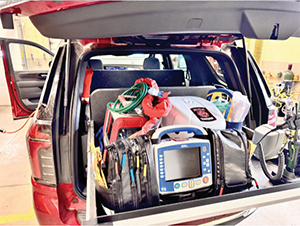
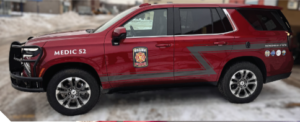
Once they received state approval, Jonassen got busy ordering equipment. He purchased three SUVs, one of which would serve as a reserve vehicle. He also added graphics and emergency lighting, and equipped each SUV with a cardiac monitor, ventilator, defibrillator, LUCAS chest compression machine, and other ALS gear and medications. The vehicles were designated as Sprint Medic 51 and Sprint Medic 52.
Next came determining coverage areas for each vehicle. St. Louis County’s geographic information system (GIS) professional compiled a heat map showing ambulance runs to identify areas that had the greatest need. Officials decided one sprint medic would serve the Tower area, which includes seven communities on the east side of the county. The other would cover the Cook, Orr, and Bois Forte areas on the west side.
How the program works
The two sprint medics run from 8 a.m. to 6:30 p.m. Monday through Friday, which data show are the peak hours of need. One Virginia paramedic per vehicle covers each shift.
Rather than hiring additional staff, the program uses a model in which existing paramedics volunteer to work overtime to cover the sprint medic shifts. These paramedics must complete specialized training before they can serve as sprint medics, Jonassen said.
“We did hundreds of hours of additional sprint medic training,” he said. “Our paramedics typically operate in crews of two, three, or four, but the sprint medics are out there by themselves. So, we worked on operating by yourself and did some extra incident command training, so they are confident getting control of an emergency scene and organizing the operations to help smoothly take care of victims.”
The Virginia paramedics also assist partner BLS services with any training they may need, such as using electronic record management systems. Additionally, paramedics are encouraged to visit partnering agencies when time allows to build trust and strengthen working relationships.
Changes and challenges
While minor adjustments have been made to the program along the way, operations have run smoothly for the most part, Jonassen said. The biggest challenge has been covering the sprint medic shifts during the summer.
“We knew summertime would be tough because it’s vacation season, and maintaining minimum operations plus the sprint medic program has put a strain on the staff,” Jonassen said. “But we expected that, and everyone has really stepped up.”
Early results
The program has received early praise from residents, Johnson said. While formal survey data is still pending, feedback has been overwhelmingly positive.
“My sprint medics say whenever they encounter people in the general public, they are extremely happy to have the sprint medics there and hope this program will continue to be funded after June 30,” Jonassen said.
“People wonder why they’re seeing a Virginia vehicle in the City of Tower, and they appreciate it when they find out why,” Johnson added. “It doesn’t matter what it says on the side of the rig; you just want to get help there fast.”
The BLS ambulance services also appreciate the program. “It’s making a real difference,” McDonough said. “We’ve seen the benefits of the program on some very critical calls.”
For example, a 3-year-old with a history of strokes experienced a seizure lasting more than 30 minutes, where rapid ALS intervention was critical, McDonough noted. There have also been several calls where ALS pain management significantly improved patient comfort during transport.
The program has demonstrated its value by improving patient care, as well as “by strengthening our ability to manage multiple calls simultaneously and ensuring our rural communities continue to receive the highest level of emergency medical care possible,” McDonough added.
Collaboration is key
The collaborative approach St. Louis County took in creating the program is a primary driver of its success.
“One unforeseen win for the program is the cooperative interoperability between not only the BLS ambulance services but the first responder groups and fire departments in the area. They absolutely love having the sprint medics there,” Jonassen said. “In my 21 years here, our relationships with our northern neighbors have never been stronger, and I think that’s a direct result of the sprint medic pilot program.”
Johnson agreed. “I think the collaboration and relationships have been excellent. People have had open minds. That’s really helped the success of the program.”
Hopes for expansion and continued state funding
Both Johnson and Jonassen are excited about the results and hope the program continues long after the pilot ends next June. They would also love to see other rural areas in Minnesota benefit, though that will require ongoing support from the state.
These small, rural communities “couldn’t afford to do this without the grant,” Johnson said.
“I think it’s an extremely important program to get paramedics out in these very rural areas and get advanced life support on scene in a timely fashion,” Jonassen added. “I’d love to see some kind of permanent state funding for this program and to open it up to other rural areas of Minnesota that are experiencing the same staffing shortages and long response times that St. Louis County has experienced.”
Claudia Hoffacker is a freelance writer.