

 or
 lines to the right of the URL bar at the top of your browser

Bits & Briefs
Turning City Deer Management Into Food Shelf Support
Managing overabundant urban deer herds is a challenge for many municipalities, but the City of Apple Valley turned its local management plan into a direct community benefit. Partnering with the Minnesota Department of Natural Resources, the city uses professional police sharpshooters for targeted herd reductions in designated green spaces after dark.
Beyond reducing traffic collisions and landscape damage, Apple Valley integrated an altruistic component: All clean venison harvested through the management program is processed and donated directly to 360 Communities, a local food shelf serving area families. It’s a model that balances ecological health with a win for local food security.
Mayor for a Day Essay Contest Submissions Due Dec. 11
The League of Minnesota Cities’ 15th Annual Mayor for a Day Essay Contest invites fourth, fifth, and sixth graders to answer the question, “What would you do if you were mayor for a day?” for a chance to win $100 and be featured in Minnesota Cities magazine. Encourage students in your community to apply, and if your city would like to offer local recognition for participants, email [email protected] by Friday, Dec. 11.
After the judging process is complete in January, the League will share essays submitted by local students with participating cities. Cities can provide recognition to students in a variety of ways — like selecting a citywide winner, honoring all participants, or finding another creative way to inspire future leaders. Details and submission materials are available at lmc.org/mayorforaday.
Pedestrian Bridge Over Elk River Highlights Power of Intergovernmental Partnerships
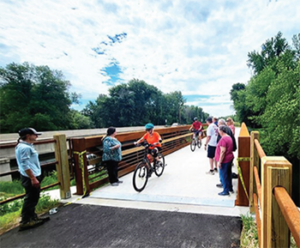
Earlier this year, a new pedestrian bridge over the Elk River was completed in Big Lake Township. Costing about $811,000, the bridge gives people a safe way to walk across a busy stretch of County Road 5 near Lions Park without dodging traffic.
This project highlights the strength and efficiency of coordinated government partnerships. First proposed in 2020, it became a reality through close cooperation between Sherburne County and Big Lake Township, along with strong backing from the City of Big Lake, local schools, and community groups. After a few initial tries, the partners successfully secured a federal Transportation Alternatives Program grant to cover the majority of the cost, with the county providing the local match.
Helping Newly Elected Officials Get Up to Speed
City staff and experienced elected officials know that understanding the complex rules and responsibilities of local government is an ongoing process. Even tested leaders frequently encounter new issues, shifting laws, and tough decisions that require research and collaboration.
For newly elected officials, however, the learning curve can feel especially steep. They are stepping into a demanding role while trying to find their footing within an existing team. Early questions often range from basic council procedures to pressing community issues.
City staff play a vital role in directing officials toward reliable information. This often includes steering them toward helpful League of Minnesota Cities resources like the Handbook for Minnesota Cities, self-paced MemberLearn courses, or events like the Elected Leaders Institute (ELI).
ELI’s Newly Elected Leaders Program provides a hands-on opportunity to understand legal roles while building a statewide peer support network. Similarly, the ELI Next-Level Leaders Program offers structured growth for experienced elected officials seeking to dive deeper into governance.
Learn more at lmc.org/newlyelectedofficials.
New US Geological Survey Tool Supports Water Planning
Minnesota cities have a new resource for evaluating water supply, demand, and long-term availability as they plan for future growth and infrastructure needs. The U.S. Geological Survey’s (USGS) National Water Availability Assessment Data Companion brings together watershed-level data that previously required planners and utilities to pull from multiple sources.
According to The Resource by the Minnesota Municipal Utilities Association, this free tool covers approximately 80,000 watersheds nationwide and allows users to review up to 40 years of monthly water-supply information, including streamflow, snowpack, and soil moisture, along with water-use data and supply- and-demand comparisons.
For city water utilities, the information could be used as another data source when evaluating system capacity, planning infrastructure investments, considering conservation measures, or communicating about water resources with residents and other stakeholders.
The National Water Availability Assessment Data Companion is available through USGS at water.usgs.gov/nwaa-data.
Grand Marais Public Library Lends Out Thermal Cameras To Reduce Winter Bills
 The public library in Grand Marais is helping residents tackle high winter heating bills by lending out more than just books — they now offer thermal imaging cameras. Partnering with local energy advocates, the library lets community members check out professional forward-looking infrared cameras for the weekend free of charge. Users can walk through their homes or storefronts to pinpoint hidden heat leaks, drafty windows, and bad insulation. It’s a creative, low-cost model that empowers residents to save energy.