

 or
or  lines to the right of the URL bar at the top of your browser
Community Voices Shape Safer Future for River Bend Park in Savage
By Deborah Lynn Blumberg
In the City of Savage, two rare nonfatal shootings near River Bend Park in the spring of 2023 shook the community and prompted officials to remove the park’s basketball hoops. Officials wanted to keep residents from congregating around the court while they investigated the Easter Sunday and late-May incidents.
Almost immediately, residents began posting on social media. Some felt frustrated that the hoops — an outlet for healthy, physical activity for neighborhood kids — were gone. Others supported temporarily removing them, agreeing the hoops should stay down until officials could explore long-term safety improvements for the park.
“There were two interested parties, each very emotionally attached to their position,” said Brad Larson, Savage’s city administrator. In response to the divided reaction, city leaders committed to a transparent, inclusive engagement process to shape the park’s future alongside residents.
“With the understanding there’s nothing we could do to 100% prevent the issue, we knew we could make the park better,” Larson said.
Savage won a League of Minnesota Cities 2025 City of Excellence Award for its community engagement work around improving safety at River Bend Park, one of Savage’s 23 neighborhood parks. The effort demonstrated how cities can prioritize safety and inclusivity through intentional, community-led design.
Listening to the community
City leaders determined that to foster shared ownership of the park’s future, they needed to hear directly from residents about their experiences, safety concerns, and ideas for improvement. They also wanted to move the discussion off social media and into in-person conversations.
As they mulled over their options, leaders reached out to a wide range of community stakeholders, including the school district and its cultural liaisons; local businesses; and diversity, equity, and inclusion consultants, to ensure they were getting a broad range of perspectives before moving forward. Ultimately, small group discussions of six to 10 residents seemed like the best way to gather useful feedback and make sure everyone could be heard.
Savage’s assistant city administrator created guidelines for staff and commissioners who volunteered to moderate the community input sessions. Before the events began, volunteers participated in short virtual training to review their roles and the discussion guidelines. Facilitators received starter questions, and each group had a dedicated note-taker. Staff also kept the mayor and City Council informed throughout the process, and council members approved the plan in early June.
“The beauty of the discussions was that they were facilitated discussions,” said Greg Boatman, public works/parks and recreation director. “It wasn’t just one person dominating the conversation. Everybody had a voice.”
The city partnered with School District 191, the Community Equity Commission, the Parks and Recreation Department, and the Natural Resources Commission on its wide-reaching engagement plan, which included community forums, targeted interviews, and outreach to neighbors, youth, and local businesses.
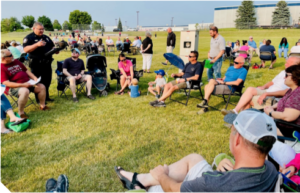
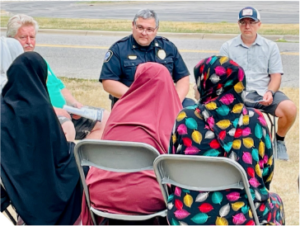
More than 200 residents attended three community forums — two in mid-June and one in mid-July. Sessions were held in the park, with residents seated in lawn and folding chairs, as well as at the fire station and a multifamily housing complex near River Bend Park.
“The forums were held at different locations because we wanted to make sure we reached all of the different stakeholders,” said Emily Gunderson, communications director.
Neighborhood youth who frequented the basketball court were among those who attended and shared their views. “The biggest challenge was to make sure every voice was heard.”
At the multifamily housing complex in particular, city staff had to be proactive and creative to encourage residents to participate. Many residents at the Winfield townhomes speak English as a second language, so the city arranged for Somali translators.
“We knocked door-to-door and asked people to come out and talk to us,” Larson said. “It was only then people came out of their homes, sat in a circle outside, and had a conversation about what was happening in the park. We had to make it comfortable for people to communicate. We got out of our comfort zone and met park users where they live.”
Turning feedback into action
City leaders sorted through notes from the listening sessions and organized the feedback into themes. They then presented the findings to the City Council.
The report included a list of tangible solutions and improvements, including better lighting and improved visibility into the park. Council members adopted the River Bend Park community engagement report in early August and an action plan soon followed.
The city partnered closely with the Savage Police Department, whose officers had received Crime Prevention Through Environmental Design (CPTED) training. CPTED is a cross-disciplinary crime-prevention strategy that applies urban planning, architectural design, and stewardship of built and natural spaces.
Often referred to as “designing out crime,” CPTED focuses on strategies that lower victimization, discourage offenders before crimes occur, and foster a stronger sense of community among residents — helping them assert ownership over shared spaces, curb crime, and reduce fear.
“It takes a while to implement these things,” Larson said.
Following CPTED principles, the city removed several large bushes and trees that had been impeding police officers’ visibility into River Bend Park as they drove by on regular patrols. Officials also added more lighting to brighten the park at night, along with additional security cameras.
When a road adjacent to the park was repaved, the city took the opportunity to add sidewalks to improve walkability and bikeability. New bump-outs in the road helped slow traffic on surrounding streets. The city also widened the parking lot entrance and added more parking spaces to accommodate visitors. River Bend’s basketball hoops were reinstalled the fall after the action plan took effect.
A park that feels like home
Perhaps the most transformative change, however, was expanded park programming. Officials encouraged local sports teams to hold baseball and softball practices and games at River Bend, and invited residents to picnic on the grounds and use the shelters. The city also installed a community garden where residents can purchase a $20 plot to grow flowers, fruits, and vegetables.
Savage received roughly $10,000 in Statewide Health Improvement Partnership grants to build the garden. After two summers, officials consider the garden a success, with nearly two dozen residents tending plots.
“We felt that bringing in more activity and more people into the park would keep a sense of community and belonging going,” Boatman said. “And we’ve gotten a wonderful response.”
The first summer after improvements began, neighbors living near the park wanted to hold a garage sale and bring food trucks into the park as part of the event. There wasn’t enough time to arrange permits, but city staff improvised — ordering ice cream, bringing speakers for music, and setting up yard games around the park.
“We encouraged the neighborhood to come out and hang out and have some fun, and the response was tremendous,” Boatman said. “I was hula hooping and jumping rope with neighborhood kids.”
Residents were able to see park improvements taking shape firsthand. “It was a chance to show the community that River Bend was a safe place,” Gunderson added.
The event evolved into what Savage now calls its annual Treats ‘n Tunes. Each summer, the city brings the community together in River Bend Park for ice cream and live music from local bands. Treats ‘n Tunes draws hundreds of residents, and the city has expanded the event to other parks on a rotating basis from May through September.
“It’s a great chance for people to get out and meet their neighbors and see who’s coming to their local park on a regular basis,” Boatman said. “It’s been very successful for building community. People are seeing that their local park is a safe and welcoming place, and a place that really feels like home.”
Gunderson said the real measure of success was turning a troubling moment for the city into a positive outcome.
“Because of the way the city handled it, we ended up turning this into an amazing unifier for the whole community,” she said. “We took the time to listen and clearly communicate our decisions. And then we celebrated by bringing our community back together again instead of sustaining the divide. This turned out to be a really positive thing in our community.”
Deborah Lynn Blumberg is a freelance writer.