

 or
or  lines to the right of the URL bar at the top of your browser
Growing Together: Wyoming’s Community Garden Expands Access and Connection
By Deborah Lynn Blumberg
 For 16 years, residents of the City of Wyoming formed friendships, built healthy eating habits, and cut their grocery costs growing their own fruits and vegetables in a community garden on the grounds of M Health Fairview Lakes Medical Center.
The garden’s 14 plots — managed by M Health Fairview — drew patients and staff from the medical center, residents of the adjacent Meadows on Fairview assisted living center, and others in the community seeking an affordable and accessible space to grow their own food. But the centrally located garden — the only community garden in Wyoming, and one of only four in all of Chisago County — had its share of challenges.
For years, the medical center had a long waitlist of people who were eager to grow their own squash, tomatoes, and sunflowers but lacked access to land.
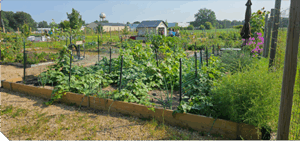
“We simply did not have garden beds to offer,” said Emily Carpenter, community partnerships manager with M Health Fairview Community Advancement. At one point, she turned away more than a dozen interested gardeners. In addition, the plots weren’t accessible for people who use a wheelchair or have mobility issues that make bending and crouching difficult.
Costs for new beds, tools, and other equipment needed for new gardeners, who pay a $25 annual fee, quickly added up. With limited resources, the medical center couldn’t tackle an expansion and renovation alone. So, Carpenter and her team turned to the city for support.
Ultimately, the City of Wyoming secured state funding and collaborated with M Health Fairview Lakes Medical Center to expand and improve the garden’s accessibility. The project earned the city a 2025 League of Minnesota Cities City of Excellence Award.
A private-public partnership takes root
Conversations about community garden expansion between M Health Fairview and Wyoming City Administrator Robb Linwood began in 2023.
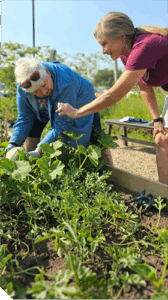
“It’s something that we at the medical center have talked about for a long time,” Carpenter said. “Our health system’s mission is to heal, discover, and educate for longer, healthier lives, and the community garden really lives that mission out. We understand the vital role that access to nutritious food plays in people’s overall health. And the community garden supports social connection, too.” The garden helps to reduce barriers and advance access to healthy and nutritious food, she added.
The project aligned well with an overarching goal of the Council’s, to help residents age happily and healthfully. With the nearest other community gardens located 15 to 20 minutes away in North Branch and Lindstrom, expanding the local garden was a logical step.
The expansion would also better serve residents of the nearby Heims Lake Villas, a growing 55-plus community.
Linwood proposed applying for an Age-Friendly Minnesota Community Grant from the Minnesota Department of Human Services. The City Council approved the plan, and the city secured more than $19,000. An additional $2,999 came from Chisago County Statewide Health Improvement Partnership (SHIP), a community-led initiative focused on building healthier communities in the state.
In addition to covering construction costs, funding also went toward purchasing new materials and shared tools for gardeners after Carpenter surveyed current gardeners about their garden wish list. She purchased a second rototiller to break up and turn over soil, a new lawn mower after the previous one fizzled out, digital water timers, shovels, rakes, and gloves. Other costs the grant money will cover include ongoing garden maintenance and periodic classes for gardeners on topics such as soil health, plant care, and harvesting techniques.
Building for access and engagement
Construction began in spring 2024, with support from city planning commission staff, their families, and other community members.
Wyoming Zoning Administrator/ Building Official Fred Weck designed the layout and helped lead the build. Over nine hours, volunteers graded and leveled the site, installed two brand new raised beds and four ground-level beds, filled them with soil, and enclosed the area with 60 feet of fencing. The garden now includes 20 beds and serves 32 gardeners, up from 14.
One of the newly added plots is used by Rise, which provides enrichment programs for adults with developmental disabilities. This is the program’s first year growing its own produce, said Jamie Farley, activity coordinator at Rise.
“We planted things we plan to use in our cooking groups in-center — zucchini, squash, cucumber, broccoli, cauliflower, tomatoes, and various herbs,” she said. “It has definitely been a learning experience so far, and we are already planning what we might do differently next year.”
Farley added that the garden gives Rise greater flexibility and efficiency than their previous produce arrangement. “Previously we had collected produce from a local CSA [Community Supported Agriculture] program, but many of the things we got posed some challenges for cooking and weren’t well liked. Unfortunately, much of it went to waste,” she said. “The community garden space allows us to customize exactly what we get and how much we can harvest.”
A garden that grows community
Today, residents age 18 and older gather at the garden to plant, water, and harvest produce and flowers. “Weekends are always buzzing at the garden,” Carpenter said. “That’s become a natural time for connection. It’s been really amazing to see the community that’s been built.”
The garden includes shared apple and pear trees, and raspberry bushes. Gardeners collaborate on weeding, harvesting, and even donating extra produce to Family Pathways, a North Branch-based nonprofit that distributes food to local families in need.
“The garden is not just about tending to your food,” Linwood said. “There’s so much more. It draws residents of all ages and backgrounds. It really is about a shared space and about building social connection.”
Carpenter notes that gardeners are especially grateful for a way to grow their own food as grocery prices rise. “They’ve told me, ‘If I can save a little by growing my own food, I’m going to do that.’”
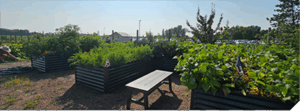
She credits the city’s support from planning through promotion: “I can’t begin to describe just how appreciative we are. They’ve been incredible partners from start to finish.”
Wyoming Assistant City Administrator Grant MacFarlane calls the renovated community garden “a great added amenity” for city residents. “Anytime you can introduce a new amenity to the community, it’s a huge draw for people,” he said. “The expanded garden is being utilized a ton; it’s been really great.”
Next steps, and lessons for other cities
Given the project’s success, there’s already talk of future expansion, especially to add more raised beds. “If M Health Fairview Lakes Medical Center can find the space,” MacFarlane said, “then we’re certainly willing to go through the process again.”
He believes that, while Wyoming’s community garden project and partnership is unique, it’s one that other cities and communities can learn from. To access funding, cities should lean on community-led initiatives like SHIP, he said.
“These organizations offering grants want you to succeed,” said MacFarlane. “Don’t be afraid to at least try.” Also, tap into city staff members’ skills and expertise, he added.
Linwood added that the project is a model for how local governments can collaborate with nonprofits and health care providers. “Don’t be afraid to reach out,” he said. “Sometimes we get siloed in our work, but when we lean on each other’s strengths, we can make a real impact in our community.”
Deborah Lynn Blumberg is a freelance writer.