

 or
or  lines to the right of the URL bar at the top of your browser
Removing Barriers: Mounds View’s Effort To Eliminate Discriminatory Housing Clauses

By Deborah Lynn Blumberg
Hidden in plain sight, small clauses in property deeds once shaped who could — and couldn’t — call a neighborhood home. For more than a century, these restrictive covenants quietly prevented people of certain races and religions from buying or living in homes.
The covenants, often inserted by real estate developers, targeted persons of color and non-Christian individuals. They fueled residential segregation that still affects communities today, limiting Black homeownership rates and widening wealth gaps.
When the City of Mounds View learned it had the second-highest number of properties in Ramsey County with discriminatory covenants, behind only St. Paul, city leaders committed to taking action.
The decision came as Mounds View’s population underwent a dramatic shift. In a single generation, the city of about 12,000 residents went from just over 1% people of color to nearly 34.7% today, with the majority living in multifamily residential housing.

“The demographics of our community are trending toward becoming more diverse year-over-year,” said Mounds View Mayor Zach Lindstrom, “and we really wanted to work on making our community more inclusive. We didn’t think we could call ourselves an inclusive community if we still had racial covenants.”
Last year, the city launched an initiative to identify and remove racially restrictive covenants from its residential property deeds. The project earned Mounds View a 2025 LMC City of Excellence Award for its efforts.
Ongoing inequality
Racially restrictive covenants have been unenforceable since 1948, when the U.S. Supreme Court’s Shelley v. Kraemer decision ruled they could not be upheld in court. The 1968 Fair Housing Act later made it illegal to discriminate in the sale or rental of housing.
In Minnesota, the Legislature prohibited new covenants in 1953, but existing covenants remained legal in the state until 1962. Even decades later, the harmful language still appears in property deeds.
In 2019, the Minnesota Legislature passed a law allowing property owners to individually discharge or renounce discriminatory covenants by recording a discharge form with the county.
Several years ago, a Mounds View resident serving on a city committee raised the issue of racial covenants with city leadership. Officials contacted the Ramsey County auditor to see how many of its residents had taken steps to remove the language from their property deed.
“The answer was, not very many,” Lindstrom said. Many residents were unaware the covenants existed. “We realized it was going to take more of a hands-on approach to deal with the covenants,” he said.
Mapping the problem
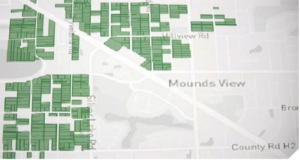
Mounds View became the first Minnesota city to partner with the Mapping Prejudice Project, a University of Minnesota initiative that documents and maps the history of racially restrictive covenants in housing. Launched in 2016 by historians and researchers, the project created the first comprehensive digital map of racial covenants in the U.S.
To date, Mapping Prejudice Project volunteers have identified more than 30,000 restrictive covenants across Hennepin and Ramsey Counties. They gathered and digitized tens of thousands of property deeds from county archives, using software to locate restrictive language. The resulting data are publicly available.
The interactive map includes property addresses, lot information, deed dates, sellers, and the original covenant language. For example, one early Minnesota restriction stated that property “shall not at any time be conveyed, mortgaged, or leased to any person or persons of Chinese, Japanese, Moorish, Turkish, Negro, Mongolian, or African blood or descent.” Covenants before 1919 also often excluded Jewish individuals.
Over time, language shifted. After the project completed mapping of Ramsey County last year, Mounds View officials found deeds in the city that included language stating, “… no person or persons other than of the Caucasian race shall be permitted to occupy said premises or any part thereof.”
“Some of these covenants were in type four- or six-point font,” said Mounds View City Administrator Nyle Zikmund. “You needed a magnifying glass to read it. We do not want this stain on our community.”
As of February 2024, the project had mapped 5,458 covenants in Ramsey County, including 531 in Mounds View.
One study from University of Minnesota researchers estimates that one-third of present-day neighborhood inequality stems from the way communities were originally built, influenced by racial covenants. The study also found that Minneapolis homes once covered by covenants have, on average, 3.4% higher current home values than those that were not.
Clearing covenants
With the covenants identified, Mounds View officials set out to help residents remove them. All it takes to remove the clause is a simple county form. “It takes about two minutes to complete,” Zikmund said.
On Juneteenth in 2023, the city shared information about the effort in its quarterly newsletter, on social media, on its website, and during town hall meetings. When that drew limited response, Deputy City Clerk Kari Tholkes and Executive Assistant Barb Collins mailed a blank discharge form (Conveyance Form 40.10.1), along with instructions on how to complete it, to the over 500 affected homes. Aside from filling out the form, homeowners had to have it notarized before the city could file it with the county.
The initial response was moderate, so the city pivoted. Lindstrom sent a personalized letter explaining the covenants and why city officials felt it was important to eliminate them. Tholkes and Collins began prefilling the form for residents, leaving only signatures to complete. They now send batches of 20 to 30 letters each week.
Residents can bring their forms to City Hall to be notarized for free. Notary and Mounds View resident Sharon Kirschner also volunteers to visit those who can’t travel. Additionally, Ramsey County waived the $46.50 filing fee, removing a financial barrier to eliminating the covenants, said Tholkes.
“Our goal now is to get 10 a week, and it’s working,” Zikmund said. “This has been so simple and transformational.”
So far, Mounds View has helped residents remove restrictive clauses from 275 residential property deeds. “It’s been overwhelmingly positive,” Tholkes said.
The city aims to remove all the remaining racial covenants from deeds, about 246 more. The only real expense has been postage for mailings to residents and to mail completed forms to Ramsey County. In fall 2025, city officials brought prefilled forms to town hall meetings for properties that still carry covenants, just in case those property owners were in attendance.
A point-of-sale solution
To further the effort, Mounds View adopted another novel solution: a point-of-sale ordinance requiring residents to complete paperwork to remove discriminatory covenants from their deed before they can sell their home.
It’s a method that will help ensure over time that all covenants are eradicated from the city’s residential deeds. Officials modeled the policy after a similar ordinance they enacted five years ago that requires sewer line inspections before home sales, which has saved the city money through preventive maintenance.
“We’ve had significant savings from those lines having been rehabilitated,” said Zikmund. Adds Lindstrom, “We’ve been able to make our water system much more efficient.”
With the point-of-sale ordinances, residents receive a certificate of compliance to keep with their property records. “Now removing the discriminatory covenant is just part of the sale of the home if it hasn’t been done already,” Zikmund said.
Most recently, the county clarified that only one property owner’s signature is needed to remove a covenant, which has further simplified the process, since it means couples no longer have to coordinate to appear together at City Hall to sign the county form in front of a notary. “We’re seeing a mini boost from that,” Zikmund said.
“We’re in the home stretch in less than a year,” said Lindstrom. “We only had to use the ordinance to discharge five or six of them. The vast majority has been people responding to our mailers and wanting to do this work on their own.”
Lessons for other cities
For other cities that want to work with residents to remove racially restrictive covenants, Mounds View officials strongly recommend starting with the more personalized mailings and targeted community outreach.
“We don’t want to catch residents at the point-of-sale,” Zikmund said. “We want people to do this voluntarily. And that personal touch does add more. It’s a marathon, not a sprint.”
“This absolutely is an initiative that any city can undertake,” Tholkes adds, “It’s reproducible with ease.”
Deborah Lynn Blumberg is a freelance writer.