

 or
or  lines to the right of the URL bar at the top of your browser
Fergus Falls Reinvents Itself Through Riverfront Revitalization
By Deborah Lynn Blumberg
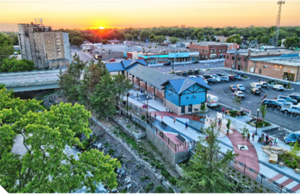
The first domino to fall in Fergus Falls was Kmart in 2014. Then Target shuttered four years later, followed by Herberger’s and Sun Mart Foods. The next year Shopko closed. Meanwhile, nearly two dozen downtown storefronts sat vacant before the pandemic. It was a wake-up call for local leaders, who had long felt the city was underusing one of its best assets: a riverfront that wasn’t fully embraced.
“We thought, we don’t want our identity to be big-box retail,” said Fergus Falls City Administrator Andrew Bremseth, who grew up in the city. “We’ve got to do something different. The question was, how do we separate ourselves, knowing that big-box stores may be a thing of the past, and with online shopping so prevalent today.”
Leaders decided to reshape the city’s identity through a major revitalization of its downtown and land along the Otter Tail River. Two years after Kmart closed, the City Council launched an 18-month master planning process. The effort featured extensive community engagement to help guide the city of 14,000 forward.
Now, 10 years later, Fergus Falls’ downtown and riverfront area is thriving, attracting residents and out-of-town visitors alike with features including a riverfront pavilion, splash pad, a weekly farmers market, and businesses such as a high-end restaurant, a new ice cream shop, and a boutique hotel.
Throughout its transformation, Fergus Falls has successfully used public projects to attract private investment, turning a difficult moment for the city into an opportunity for long-term growth.
Reimagining the riverfront
Fergus Falls’ Downtown and Riverfront Master Plan identified six focus areas. “The crux of original conversations were that we have this beautiful asset, the river, and how do we make it our front door as opposed to back door,” Bremseth said.
The areas included two riverfront parking lots, a former dairy processing plant, a historic mill that had sat vacant for decades, a former big-box store, a privately owned retail strip, and a space between City Hall and the county courthouse.
The City Council approved the master plan in December 2017. As an early step, the city acquired the privately owned dairy plant, and began demolishing it and cleaning up the site. The land is now available for development.
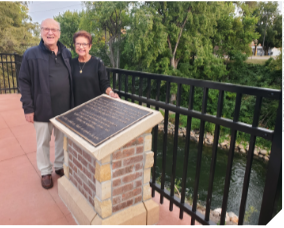
Around the same time, officials began planning a revitalization of Spies Riverfront Park, named after longtime Service Food Market owner and community leader Gary Spies and his wife, Sharon, both of whom died in 2025.
“We needed things for kids to do, and public spaces so we could all collectively enjoy the natural resources and assets,” Bremseth said. “Our focus was on family friendly and creating destinations. We were being very mindful about creating a place that people would choose to come and raise their family.”
Community support takes shape
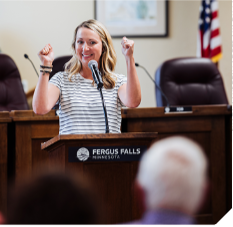
As plans developed, resident Tasha Rohlfs, and other local moms — tired of driving their kids all the way to Fargo to find an indoor playground — spearheaded the creation of a children’s museum in a vacant downtown space in 2018.
“We wanted to be a part of the revitalization downtown,” Rohlfs said.
The prospect of a future splash pad nearby was a major incentive to move forward with fundraising for the museum, she added. A team of 10 mothers, including Rohlfs, raised $1 million.
“The community knew this could attract out-of-town traffic and really become something special in the region,” Rohlfs said. The Otter Cove Children’s Museum had its grand opening in fall 2020.
The following year, the city broke ground on phase one of the riverfront project, building a new three-season pavilion along the riverfront. Community members can rent the space for events such as birthday parties, weddings, and church services. The structure is open-air, but retractable garage doors and heaters make it usable through early winter.
After opening in 2022, the pavilion became home to the Fergus Falls Farmers Market on Saturday mornings. In 2025, it hosted 74 private rentals, and midway through 2026, it already had 48 private event reservations.
“It’s a really beautiful space,” said Bremseth. “People are always sitting there having lunch.
Creating new destinations
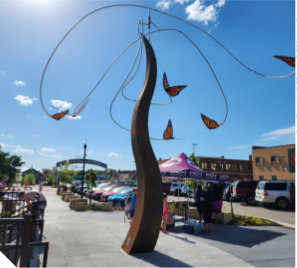
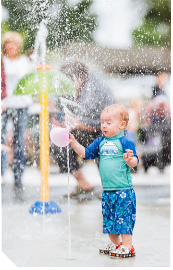
Launched in 2023, phase two of the revitalization project included installing a splash pad and riverfront balcony connecting the park’s two main spaces. The splash pad opened in 2024. Together, the pavilion, splash pad, and redevelopment work at the former dairy cost the city more than $13 million.
For the splash pad, the city drew inspiration from the 1980s-era concrete otter bollards that once protected city pedestrians. While they now sit in storage at City Hall, a local artist used the statues’ design as a template to create playful, water-spraying otter features for the splash pad.
“Kids absolutely adore the otters,” Bremseth said.
During the summer, it is no longer unusual to see license plates from a dozen states parked along city streets, “which is certainly something new to us,” Bremseth said. “We’ve been very intentional about creating quality-of-life amenities people can really be proud of.”
Public investment attracts private development
To fund the revitalization, Fergus Falls assembled a mix of state and local bonding dollars, federal COVID-19 relief money, Minnesota Department of Employment and Economic Development loans, community donations, and grant dollars.
The grant funding included support from the Legislative Citizen Commission on Minnesota Resources, which makes recommendations to the Legislature for environmental and natural resources projects funded primarily through the state’s Environment and Natural Resources Trust Fund (ENRTF).
For phase two of the project, when additional state bonding dollars did not materialize as expected — due in part to higher construction costs — city officials turned to residents to help close the gap. “And the community really stepped up,” Bremseth said.
A local family trust agreed to contribute $1 million to the project if the community could match it. Led by Rohlfs and resident Peggy Underwood, the fundraising efforts ultimately raised the full $2 million for phase two of the redevelopment.
The public investment helped to attract private investors and business owners to Fergus Falls.
“A lot of progress has come from the city taking that first step in investing,” said Bremseth. For example, Uncle Eddie’s ice cream parlor moved forward with opening a shop in Fergus Falls after learning about the city-backed pavilion and splash pad plans, he added.
Fargo developer Kevin Bartram also watched with interest as redevelopment plans took shape. Public investment, the pavilion’s completion, and the addition of nearby parking convinced him to move ahead with plans for a 32-room boutique hotel with an industrial design inside the former century-old Red River Flour Mill.
The city helped secure a financing package that made the project viable. It included tax increment financing, federal historic tax credits worth 20% of eligible rehabilitation costs, and a direct low-interest loan. The Mill Hotel opened in 2025.
“The programs the city had were critical to being able to put the project together,” Bartram said. “Without it, it would be an empty building right now.”
Meanwhile, infrastructure investments also helped spur the opening of Töast, an upscale Scandinavian-inspired café, and Outstate Brewing Company.
A community-driven vision
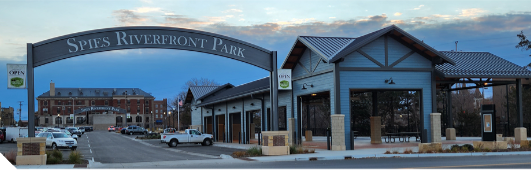
The city has received multiple awards for its downtown riverfront improvements project, including the 2019 American Planning Association Minnesota District Director Award for its Downtown & Riverfront Redevelopment Plan, the 2024 Project of the Year in the non-transportation category from the City Engineers Association of Minnesota, and the 2024 Project of the Year in the outstate category from the American Public Works Association Minnesota Chapter.
Bremseth said it was critical to engage all stakeholders early in the process, including nearby property owners.
“We listened to what the community wanted to see and use,” he said.
That outreach included meetings with the local senior center, high school students, service groups, and business-specific roundtables.
“You name the sector, and we probably had the meeting or multiple meetings,” Bremseth said.
Community members had early access to renderings, maps, drawings and diagrams, and they were encouraged to provide honest feedback.
“We really let the community design these spaces,” Bremseth said. “And today, Fergus Falls feels vibrant and full. I’ve never seen this number of people in downtown Fergus.”
Deborah Lynn Blumberg is a freelance writer.