


 or
or  lines to the right of the URL bar at the top of your browser
Helping Small Cities Plan Big Projects
By Suzy Frisch
Beach Park in Lindstrom offers a charming place for residents and visitors to swim, fish, picnic, and play. Yet its parking lot often floods, the shoreline is at risk of erosion, and it can be difficult to navigate to the Chisago Lakes area park.
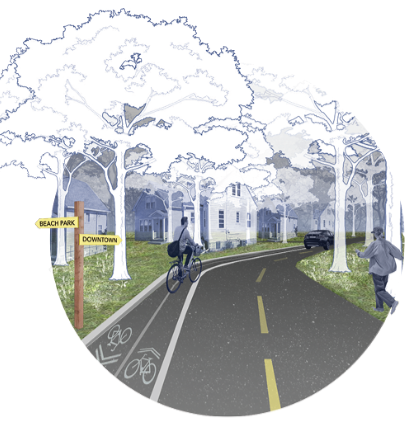
Like many smaller cities, Lindstrom struggles to find the time and resources needed to plan and carry out infrastructure projects. It’s not for a lack of desire to improve their communities. Many cities with populations under 15,000 have small staffs with long to-do lists. Often, their budgets don’t stretch far enough to cover the early planning work needed to apply for infrastructure funding.
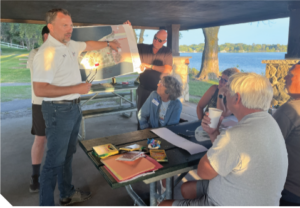
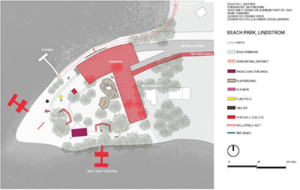
But thanks to the state’s Empowering Small Minnesota Communities (ESMC) program, Lindstrom worked with the University of Minnesota to develop potential improvements to the 3-acre park. A team from the university’s Minnesota Design Center and Center for Urban and Regional Affairs created a plan after engaging community members and completing a design session with park and city leaders. Their multifaceted approach would move the parking lot, stabilize the shoreline with a new rain garden, and create a boardwalk over South Lindstrom Lake. It also called for redesigning an underused pavilion and improved trail connections to the Swedish Immigrant Regional Trail system.
The process and results have been invaluable for Lindstrom, including building strong community engagement and support for the Beach Park project, said City Administrator Dan Undem. “It was mind-blowing to see what came out of it and watching the community rally behind the plan,” he said. “Had we not engaged with ESMC, this park plan would not have been done, or it might have been done five to 10 years down the road.”
The city doesn’t have a robust pot of planning funds, so “getting this opportunity with ESMC and working with the university has really allowed us to tackle a park planning project,” Undem said. “Now we have professional documents we can refer back to and look for funding for it.”
A state program designed for small cities
To help meet the needs of cities like Lindstrom, the Minnesota Legislature created ESMC in 2023 and renewed it in 2025. The program brings together the resources and expertise of the University of Minnesota to help local governments lay the groundwork for infrastructure projects. Cities work with experts from the University’s Center for Transportation Studies, Extension Regional Sustainable Development Partnerships, Minnesota Design Center, Humphrey School of Public Affairs, and Center for Urban and Regional Affairs. Professors and students from across the university also participate in ESMC initiatives.
ESMC aims to help small communities strengthen their social, environmental, and economic fabric by assisting with wide-ranging infrastructure projects. Participants engage in planning, design, and early-stage development work that can help them create competitive applications for grants, state bonding funds, or other state and federal investments, said Mike Greco, director of the Resilient Communities Project in the Center for Urban and Regional Affairs.
“Often smaller communities are not able to compete against larger cities with staff who are more experienced in grant writing, and they are often at a disadvantage when they try to apply for state and federal funding,” Greco said. “The idea is to help them get to the point in their planning so that they have the materials they need to apply successfully.”
The Legislature has provided $9 million total to ESMC. That funding paved the way for the program to partner with 75 communities to date — 45 in the first round and 30 in the second. It is now evaluating applications for the third round and will likely select 20 to 30 projects, said Kyle Shelton, director of the Center for Transportation Studies. From downtown revitalization to flood mitigation and housing development, ESMC has helped participants engage in early-stage planning for sustainable and adaptable infrastructure projects.
ESMC works with local units of government with populations under 15,000, with priority given to those under 5,000. Partners include counties, cities, townships, school districts, special districts, tribal nations that share boundaries with Minnesota, and nonprofits or community organizations that partner with local governments. Communities also can collaborate on projects.
Building capacity for long-term planning
Participants have worked on short-term tasks like creating maps or conducting policy research, as well as long-term projects such as developing a community center or enhancing public transportation services. A third option involves broader community strategy work. Participants dive into multifaceted issues that often involve several communities, Shelton said. That might mean working in a cohort to address challenges like water infrastructure, workforce development, or clean energy infrastructure.
Once ESMC has completed its work, local governments can use their plans and materials to apply for grants or bonding funds. The program’s Grants Library provides detailed information about funding opportunities, allowing users to filter by type, location, or other requirements. The League of Minnesota Cities also offers assistance, including its Grant Navigator program for members. Cities can apply for $5,000 awards to support grant research and writing. Funds are limited. Learn more at lmc.org/grantnavigator.
ESMC is essential because many small communities simply weren’t applying for larger state and federal grants. The time and financial commitment needed to build a strong case for funding is too onerous, said Beth Labenz, executive director of the Southwest Regional Sustainable Development Partnership. Many small cities have only one employee and they often lack the expertise in creating maps and conducting the research needed for competitive grant applications.
“Something we hear a lot in southwestern Minnesota is that their infrastructure is getting old and starting to fail. They need big money for big projects, but they aren’t competitive going against the big cities,” Labenz said. “We can connect communities to university capacity and expertise, and really help leverage them to get on the same playing field as larger communities.”
Encouraging communities to think bigger
A key part of ESMC is helping cities think more broadly about the infrastructure investments they plan to make. Instead of focusing only on reconstructing a road, for example, university experts encourage communities to consider additional features such as improved stormwater practices or developing better connections within and outside the community.
“It’s really thinking holistically and more at a systems level for these investments. That’s a better use of public dollars and a good way to revitalize communities,” Greco said. “They can recognize multiple benefits from an investment, and that’s going to make them more competitive when they apply for funding.”
Greco saw this more comprehensive approach in Harris, a city of 1,100 just north of the Twin Cities along Interstate 35. Anticipating significant future growth, Harris initially sought to reinvigorate its downtown. As a new advisory committee worked with ESMC, a fresh vision for the city emerged that emphasized creating a more walkable community. The plan would develop trails linking downtown to Harris residential areas and amenities like parks, ponds, wetlands, and Goose Creek. Greco’s team also connected the group with a housing expert to better plan for residential development that accommodates population growth.
The level of community engagement and residents’ fresh ideas have been powerful components of ESMC’s work, Greco said. Encouraging their participation and feedback helps create public support and momentum for infrastructure initiatives.
“It’s a good demonstration of how a thoughtful, engaged public can bring really innovative ideas and create buy-in in the form of public investment,” he added. “These infrastructure investments will ultimately take some public dollars, and it’s much more likely that communities will proceed if they have public sentiment behind them.”
Preparing for future challenges
Residents also became engaged in an ESMC project in Morton, a Minnesota River community of about 400 in the bluffs region of southwestern Minnesota. Nestled at the bottom of a valley, Morton is prone to flooding during heavy rainfall. It experienced a 50-year storm in 2018 and a 100-year storm in 2019, causing the Birch Coulee Creek to overflow its banks and damage roads, homes, and other infrastructure.
Morton once had a flood mitigation committee and previously partnered with Renville County and an engineering firm to add retention basins and improve storm sewers during a county road construction project, said Mayor Tim Schablin.
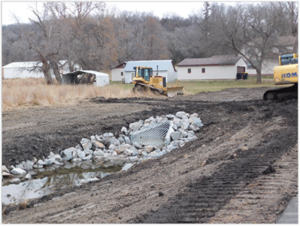
Looking to do more to prevent future flood damage, Morton connected with ESMC through the university’s Extension Regional Sustainable Development Partnerships. A team of Humphrey School students helped with community engagement efforts focused on flood mitigation on private property. They also focused on emergency preparedness in the city, including updating Morton’s emergency management plan, creating an inventory of its emergency response resources, and identifying aging and vulnerable residents.
The group also explored potential flood mitigation options to prevent flooding in Morton’s park. Possibilities included wetland expansion with a water storage basin, developing rain gardens, and widening the park’s existing channel to increase capacity. After recommending the rain garden approach, the students helped Morton identify potential grants to pursue, Labenz said.
Schablin found it valuable to work with ESMC on flood prevention. “The biggest thing was helping give people ideas on how to better prepare so that the damage might be less next time. Quite a few people took advantage of their advice,” he said. “The university has the resources to find out what you would like to know, and the students worked hard at helping us. They came up with a lot of ideas, and they were always there.”
Taking time to think strategically about current and future infrastructure challenges is a major part of ESMC, especially in the face of climate change and the ongoing need to repair and update infrastructure, Shelton said. “Our goal is to augment cities or communities’ capacity that makes it more manageable and allows them time and space to say, ‘Here is the biggest thing we need to do,’ rather than trying to do multiple things,” he added.
“It gives them breathing room to tackle a problem. We also hope that this opens doors to other resources that help them check off some of their longer-term needs.”
Suzy Frisch is a freelance writer.