


 or
or  lines to the right of the URL bar at the top of your browser
Meet Our Team: Q&A with IT Member Consultant Matt Nelles
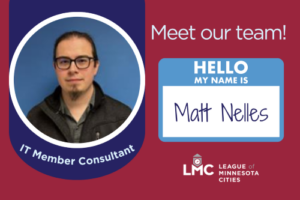 From cybersecurity and AI to helping cities navigate .gov domain requirements, Matt Nelles works with Minnesota cities on a wide range of technology challenges and opportunities. As an IT member consultant, Matt helps city staff of all experience levels better understand and utilize technology to support their work.
In this Q&A, he shares more about his professional background, current priorities, and how the League’s IT team supports members across the state.
Q: Please describe your professional journey and what inspired you to focus on information technology (IT), especially within local government.
My dad was in IT, so I started learning about the field when I was quite young and never stopped. I’ve worked in all the main areas of IT, so I have acquired a broad knowledge base that expands in many areas.
When I got into college, I started transitioning into management roles. That really helped me develop the ability to use all of my skills to help teams working on various projects while communicating goals and ideas to other groups who may not be versed in those areas.
For the last eight years, I had been working for the federal government in Western Area Power Administration (WAPA) as the lead system administrator for the Upper Great Plains region. When things shifted there and I found the posting at LMC, I thought, “Why don’t I just transition to local government and continue doing the same type of work I enjoy, but on a more direct and local scale.”
Q: What types of IT support and guidance do you typically provide to members?
A lot of the big issues right now are artificial intelligence (AI) and cybersecurity. Those issues are typically where cities start off when we start talking, but often I find that everyone is just looking for how they can expand or what they can do better. That’s typically what the conversation always boils down to. You can’t know what you don’t know, so it’s just a lot of discussion of where can we expand and what can we do with technology.
I help members of all skill levels, from IT administrators to clerks who also have to be their city’s IT person and are trying to figure things out as they go.
Q: What are your top priorities this time of year, and what are you working on now?
Right now, because it’s nice out, the priority is getting out across the state and connecting with members as much as I can.
Another major focus of mine is continuing to develop and improve MemberLink. We are working to reestablish the IT Professionals MemberLink community and make it a more helpful and active resource for members. We’re also looking at ways to improve and update the MemberLink platform overall by adding new tools and capabilities.
Q: What are the most frequent issues or concerns you address during consultations with city staff?
It’s a lot of AI, cybersecurity, and .gov domain requirements. Like I said, everyone is trying to understand what they can do better and move forward with technology in a practical way.
Q: What is one thing that you wish members knew about your team?
With the IT team, everyone is super friendly and helpful, so if you need anything, know you can just reach out to our team as a whole. I can help on the member side, and the rest of the team can help internally.
On the Insurance Trust side with Christian Torkelson, member cities are welcome to reach out to myself or Christian, and we’ll figure out which one of us is best to handle the request. Otherwise, we’ll both kind of jump in for trainings or different things like that. It sometimes comes down to whoever is available, but we also have areas we excel in.
Christian is so used to how local government works, and I have a lot of experience with policy writing related to North American Electric Reliability Corporation (NERC) and the Federal Energy Regulatory Commission (FERC) standards and requirements. My specialty is a lot of figuring out how we can help the cities meet standard levels of security.
Obviously, budget is a huge consideration for a variety of cities. Cities with larger budgets can meet requirements exactly to the letter, but cities with smaller budgets can still meet most of the requirements or expected standards in other ways. My job is helping them get there.
Q: Why do you do what you do? What do you enjoy about your job?
My mom was a teacher for all of my childhood, so I grew up in the education side of things, and I like that a lot. I just dislike the structure and overarching base way that normal education functions. I love this type of job because it allows me to act in that educator role while making it adaptable to whatever a member needs to understand it and apply it.
Please don’t hesitate to reach out with any IT-related inquiries! I’m happy to offer minor tweaks that might improve your workflow or tackle the larger issues with you.