

 or
or  lines to the right of the URL bar at the top of your browser
Grant Navigator Helps Cities Unlock Millions in Project Funding
By Suzy Frisch
The historic Sandstone School building sat vacant and crumbling for over two decades, the subject of many renovation ideas that never materialized. Perched on a hill above Sandstone’s downtown, the abandoned building had become a sore spot for residents and a formidable problem for city leaders.
“It’s a very noticeable and very sad visual for the community to see the building just standing unloved, unused, with broken windows, and roof damage causing it to get wet inside,” said City Administrator Kathy George. “People in the community really tried to get something going, but it’s really hard.” Known as The Rock, the three-story building made of locally mined sandstone was built in 1901 and is listed on the National Register of Historic Places. After the school district opened a new building outside of town in 2004, The Rock began its slow decline, marred by vandalism, decay, and infiltration by animals and mold. Sandstone experienced numerous ups and downs with different owners and their visions for the building, but no real progress.

Finally, plans came together for a $17.7 million transformation of The Rock into 32 units of workforce housing. But pulling together the necessary resources — particularly grant funding — proved daunting. That’s when Sandstone turned to the League of Minnesota Cities’ (LMC) Grant Navigator program, a resource designed to help cities navigate the complex grant application process.
The League launched the Grant Navigator in late 2022, aiming to help cities pursue funding for essential projects. There were multiple reasons to create the resource, said Luke Fischer, LMC executive director.
“Cities operate in an increasing complex environment and funding is challenging to come by. Projects have been more expensive, and navigating state and federal systems to find the funding is as challenging as it’s ever been,” he said. “This program strikes at those issues and has enabled cities to find their way to pots of funding that are out there.”
Another goal, Fischer adds, is to “demystify the grant process for cities” and make it easier for local leaders to apply for funding.
Funding in action
In 2024, the Sandstone team applied for and received a $5,000 Grant Navigator award, which it used to hire consulting expertise for a highly technical application for a Minnesota Department of Economic Development (DEED) redevelopment grant. That effort paid off. In all, Sandstone leveraged its Grant Navigator award into a $932,733 grant from DEED, George said.
From there, additional pieces started to fall into place to make the restoration possible. Sandstone secured $3.9 million from the Minnesota Housing Finance Agency to support affordable workforce housing. It also landed two grants from the Minnesota Historical Society totaling nearly $575,000 for construction documents and roof replacement.
Overall, the Grant Navigator funds gave Sandstone the momentum it needed to transform its landmark building. “To have the League involved in a project like this is huge. It helped the city say yes to the cost for writing grants,” George said. The renovation is currently underway with completion expected in summer 2026. “People in town are so happy. They are just tearful. They never thought they’d see the day.”
Opening doors for small cities
LMC created the Grant Navigator program with $500,000 in proceeds from a land sale, supplemented by $300,000 from local foundations. While the funds last, cities can receive one grant for up to $5,000 to cover grant research and writing expenses. Cities with a second project that advances environmental or climate change goals can apply for additional dollars provided by the foundations. This award will provide up to $10,000 each to cities that highlight their projects’ environmental benefits.
The program was developed in response to feedback from local officials across the state, who described steep barriers to obtaining grants for their cities’ needs. When LMC staff asked about the biggest constraints — time, expertise, or the lack of resources like staff or consultants — the response often was, “You have to spend money to make money,” Fischer said. “That is a challenge in a lot of communities, particularly smaller cities. We designed the Grant Navigator to give local officials the resources so that they can spend money to make some money. And we wanted to make the program about as easy as possible for cities to participate in.”
Cities can apply to LMC’s Grant Review Committee on a rolling basis and typically receive a decision within 45 days. To keep the process simple, the application requires only four key pieces of information:
- A description of the project, including cost, duration, and readiness.
- A project team, such as a consultant, industry partner, or financial adviser.
- Documentation of project readiness.
- A city council resolution of support.
The League aimed to create a way to help the state’s smaller communities find and gain access to federal funds, especially after Congress and President Joe Biden enacted the 2021 Infrastructure Investment and Jobs Act and the 2022 Inflation Reduction Act. They provided billions of dollars for capital projects — the biggest federal investment in infrastructure in United States history — including hundreds of new formula and discretionary grant programs, said Daniel Lightfoot, LMC senior intergovernmental relations representative and federal relations manager.
In Minnesota, an extra challenge is that 700 of 856 cities have populations under 5,000 people, and they may have as few as just one or two full-time employees. Comparatively, larger cities often have a team including engineering and public works experts who can contribute to grant writing. The application process becomes unobtainable for many small cities when they need to hire outside experts to help with technical details, Lightfoot said.
“Even if a city of that size had an opportunity to apply for grant funding at the federal level, a lot of times the juice wasn’t worth the squeeze,” Lightfoot said. “When you’re putting together a 60to 100-page grant application for infrastructure projects, there are numerous pre-engineering requirements and financial modeling requirements. This process can be prohibitive from a workload perspective for most of these cities.”
Statewide impact
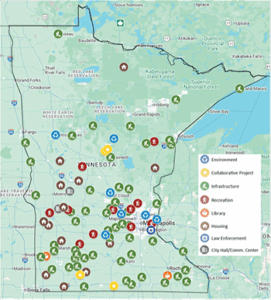
As of September 2025, the Grant Navigator program had distributed $520,425 to 90 cities for 96 projects. Of those, 83 were located outside the Twin Cities metro area, 63 had populations under 2,500, and 13 received supplemental environmental funding.
“We wanted to create a level playing field for these really small cities to get resources they can use to apply for these opportunities,” Lightfoot said. “A lot of the communities that have taken advantage of the grant program have said this is often the difference between applying for something or not.”
Those awards helped cities secure more than $33 million in outside grants, supporting nearly $100 million in projects statewide. Funded efforts include outdoor recreation, housing redevelopment, public libraries, water main and sewer repair, transportation upgrades, and city hall and community center initiatives.
Thanks to Grant Navigator support, cities received grants from the federal Department of Energy, U.S. Department of Agriculture Rural Development, federal Highway Safety Improvement Program, Minnesota Department of Transportation, Minnesota Department of Natural Resources, Minnesota Pollution Control Agency, the Twins Community Fund, and more.
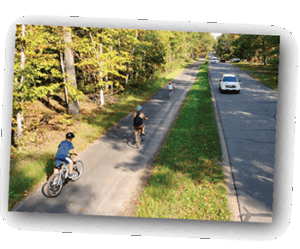
For example, Lake Shore used a 2024 Grant Navigator award to secure a $2.5 million Legacy award from the Greater Minnesota Regional Parks and Trails Commission. The funds will be used to complete the city’s .78-mile portion of the Gull Lake Trail, finalizing the 21-mile loop around the lake and connecting Lake Shore with neighboring Nisswa.
Of course, not every city that uses Grant Navigator dollars for grant applications receives funding. But it can still be valuable to go through a cycle and get feedback on how to improve a grant application for the next round.
“We hear from cities that they learned something important along the way, and the learning is often as important as the funding that’s earned,” Fischer said. “The Grant Navigator has been an overwhelming success. We’re really proud of the program and I think it hits the mark with our members who have utilized it.”
Suzy Frisch is a freelance writer.