


 or
or  lines to the right of the URL bar at the top of your browser
Mapleton Invests in Child Care House To Support Local Families
By Heather Rule
When people think about a city’s infrastructure, they often think of roads, parks, water and sewer systems, and police and fire stations. But there’s another essential need that’s often overlooked: child care.
“We’ll build roads, and we’ll build parks and playgrounds … but we haven’t really been on that page as far as looking at day care,” said Mapleton Mayor Jeff Annis.
That changed when Annis, a lifelong resident of Mapleton, became mayor in January 2023 and saw developing a child care option as a key opportunity for community growth. He noticed many families traveling outside the city to find care. As the city looked to attract more families and businesses, the lack of child care made those prospects “a tough sell,” Annis said.
“We weren’t able to grow the way we’d like to. Whether it’s housing, jobs or child care, we as a community will not grow until we have those three things in place and moving all in the right direction,” he added.
Identifying the right fit
To address the shortage, the city partnered with the Southern Minnesota Initiative Foundation (SMIF) to assess local needs and explore potential solutions.
“I think anyone you talk to within small communities will say it’s always an issue — having enough day care slots available for kids,” said James Gordon, market president of Pioneer Bank and the Mapleton Economic Development Authority (EDA) chair.
The city considered various options, such as evaluating available spaces that could be converted to create a child care center. But those models came with significant costs and operational challenges.
The generic answer to a child care shortage problem is usually “let’s build a center,” said Jeff Andrews, president and founder of Business of Child Care, but the math behind that doesn’t always work.
A more flexible solution
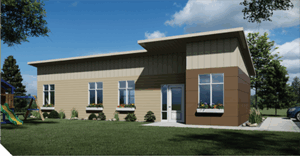
Ultimately, the city landed on a creative alternative: building a “Child Care House” from Business of Child Care.
Instead of a larger child care center, this facility is essentially “a house that’s day care ready,” Annis said. It’s an opportunity to address the need with new child care spaces in the community while allowing for some flexibility with the building in case it doesn’t go as planned, according to Gordon.
Located a few blocks from the new K-12 school and main city park, the 800-square-foot Child Care House began construction in early August. Once completed, it will accommodate eight to 12 children in alignment with child care licensing rules.
“The nice thing about this whole concept of a Child Care House is … if it no longer needs to be, or can’t be a Child Care House, we can then put it back out into the market as a one-bedroom house,” Annis said.
The Mapleton EDA owns the property and will lease the home to a selected provider. A committee selected the operator in late July through a facilitated process, who will run the business from the house. The facility will be outfitted with appliances, furniture, learning materials, and an outdoor playground.
Funded largely by grants, including a significant contribution from the Minnesota Department of Employment and Economic Development (DEED) and a T-Mobile Hometown Grant, the total cost is about $300,000. That’s a fraction of the estimated $3 million it would cost to build a traditional center, Annis noted.
Gordon noted that the custom funding roadmap was created by the team working on behalf of Business of Child Care. He added that the EDA collaborated with grant writers throughout the process, and the Mapleton City Council and staff were supportive partners along the way.
Economic and community impact
Gordon emphasized that the project’s affordability is a major asset.
“It’s been pretty exciting to think that we might have a solution that doesn’t necessarily put a huge burden on our own community,” he said.
The versatility of the house also makes it a model for other small cities. Annis noted that only a few states currently allow this kind of facility. The house supports local economic growth and helps families avoid long commutes for child care, such as driving 30 miles to Mankato to drop off kids and then return to Mapleton for work.
“When you have day care options available, you’re more attractive to people moving to your community,” Gordon said. “If you have no day care available for a young family, they’ll probably look elsewhere.”
Community feedback has been positive, Annis said, especially in response to the project’s fiscal responsibility and the new child care option it will provide.
“Local parents have expressed how exciting it’s going to be to have a place like this,” Gordon added. “The one thing that we didn’t anticipate … just the excitement that we’ve seen from other small communities in the state of Minnesota.”
Tailored to Mapleton
Annis and Gordon emphasized that a Child Care House is the right fit for Mapleton — not a one-size-fits-all solution. The city can make this work and have a cash flow with the potential to create another Child Care House to “strategically put these in where it makes sense” both practically and financially, Annis said.
“A child care center in maybe a bigger community or a different community may work out,” Annis said. “But for us, just because of the way Mapleton is structured right now, it just didn’t work. But the Child Care House does.”
“So, there’s no right answer or wrong answer. It’s what works for each community.”
Mayor Annis has shared the concept in roundtable discussions across the state, encouraging other city leaders with similar child care shortages to assess their unique needs and explore alternative solutions. Gordon stressed the importance of early planning, understanding community needs, engaging stakeholders, and identifying funding sources.
Andrews encourages communities to “start by localizing,” without coming into it attempting to solve the entire problem of a child care shortage. Even adding one provider can make a big difference — helping 10 children, their families, and their employers. “That’s a much more consumable, achievable target than saying, ‘gosh, we need $5 million to solve that,’” Andrews said.
A lasting investment
City leaders juggle a long list of priorities — from roads to fire trucks to municipal liquor stores. Andrews says adding a Child Care House is a wise investment.
“Just keep in mind this is one that really does keep giving back,” Andrews said. “Not just in year one, but over time. And when you’ve got folks that can keep their kids closer to home, they can also keep pursuing their goals in life.”
Heather Rule is a freelance writer.