

 or
or  lines to the right of the URL bar at the top of your browser
Meet Our Team: Q&A With Events Manager Carlie Windom
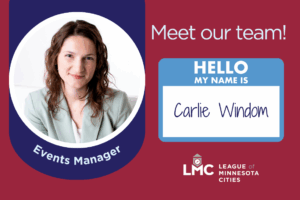 Whether it’s a small group workshop or the League’s Annual Conference, there’s a dedicated team behind the scenes making sure every detail runs smoothly. Carlie Windom, the League’s events manager, shares insights about what goes into planning events for Minnesota’s city officials—from negotiating contracts to ensuring accessibility, and everything in between.
Tell us a little about your background and how you came to work at the League.
I’m the events manager here at the League in the Communications and Events department and have been in this role for a little over three and a half years. Before that, I worked in higher education, specifically in graduate admissions at a local Twin Cities university. That’s where I got my first taste of event planning—helping with open houses and information sessions for prospective students.
Can you share an overview of your role as events manager?
The events team handles the logistics and execution of all League programs and events throughout the year. As the events manager, I work closely with both internal subject matter experts and sometimes external speakers. I also collaborate with the League’s learning team to support planning and execution for all kinds of learning opportunities for city officials and staff throughout the year.
This work has a lot of pieces. It involves things like researching venues and vendors, negotiating contracts, managing budgets, coordinating staffing, and working with speakers to ensure their needs are met all while making sure our events support the League’s learning objectives. And really just helping to manage all the variety of details that go into making our events run smoothly.
What does a typical day or week look like for you?
I rarely do the same thing every day or week to week, which keeps things interesting. This work sometimes feels like time travel, because I might be wrapping up an event and talking about what did and didn’t go well, planning another for next month, and negotiating contracts for something a year or two out, all in the same day.
In events work, there’s a lot of unexpected things that come up. We try to plan for everything, but I feel like there’s always something on our plate that we didn’t anticipate or a challenge that we have to work through creatively.
How is the events team structured, and how do you divide responsibilities?
In addition to myself, there are three other staff members on the events team: two event coordinators and a registration coordinator. The event coordinators and I do similar work but take point on different events. One event coordinator serves as our primary contact for affiliate partner events, while the other focuses more on programming for the League’s Insurance Trust. But all of us chip in and help with whatever comes up.
Our registration coordinator handles registration and check-in processes for all of our events and also coordinates sponsorships programs for the events that do have some sponsorship opportunities, as well as the League’s exhibit hall at the Annual Conference.
What kinds of data or feedback do you use to shape League events?
My team is always looking for ways that we can improve League events, and we gather feedback a few different ways. One of the primary ways that we get feedback from members is our program evaluation, so we really appreciate the time attendees take to fill out our evaluation after an event. We meet as a team and talk through evaluation results; we read every comment and are always trying to find ways to incorporate that feedback into future planning.
We also get feedback anecdotally, too. We’re always open to hearing things onsite, and we really appreciate when someone stops by at the Welcome Center or grabs a League staff member and says, “Hey this would work really well,” or “I saw this at a different event…” There’s a lot of creativity out there in the events world, so new ideas from our members or staff are always really valuable to us.
Also, as a team, we all take notes during an event. You might see us at events with notepads, jotting down what went well or didn’t go well, or ideas we can try in the future. We meet with a lot of the League staff involved in the event to identify ways to improve. We’re constantly trying to tweak our work and our members’ experience.
What types of events do League members seem to find most valuable?
I don’t know that there’s one type of event that stands out as “most valuable.” One thing that’s special about the whole calendar of events at the League is that we are trying to have a variety of formats to meet everyone’s individual needs.
Across all of our events, we consistently get the feedback that the connections that our members make with each other at events or online is really valuable in generating ideas, knowing who to ask when you have a question, or just debriefing different experiences. Networking—especially at in-person events—is very valuable to our members, and we’re always trying to find ways to support members making those connections at our programs.
How does the events team work to make events inclusive and accessible to all city officials?
We’re trying to have different event formats, but also when it comes to our in-person events, we are always trying to ensure that the events are accessible and inclusive for all city staff. There’s a lot of resources out there, and the events industry is always evolving best practices for accessibility and inclusivity. We try to stay on top of other trends and learn what other organizations are doing. There isn’t really an end goal with accessibility and inclusivity; it’s something that will always evolve.
One big area of accessibility that my team always has for events is around food safety and allergies. That’s a really common one; we’re always trying to think about common food allergens and trying to better plan menus that are safe for everybody.
We also work closely with the learning team to think through accessibility from a learning standpoint, which can include things like ensuring we have the correct technology in the room or that learning materials are accessible before and after an event.
Outside of those things, we also look to connect with individuals who have other accessibility needs. My team works one-on-one with members in those cases to identify ways to make the event more accessible for them. I hope our members know that we really do care about providing them with the best experience at each event, and if there’s an idea or something that a member needs that might improve their experience, we would really love to connect and make that happen for all of our attendees.
What’s something people might not realize about what it takes to pull off a League event?
To some extent, how early we start planning events might be a surprise to some people. We typically work on an event for at least a full year and much of the program details are ironed out early as we work to plan a smooth, engaging, and learning packed event experience. If you have an idea or feedback, the earlier you get it to us the better because we’re probably talking about the event earlier than you think.
What’s a recent event you’re especially proud of?
The League’s Annual Conference is one of our more recent events and is also the League’s biggest event. The energy that we get with the 600-700 city officials who come, all of our exhibitors, speakers from all across the state, keynote speakers from all across the U.S., and the large number of League staff – it’s unique, rewarding, and a lot of fun.
How do you see the League’s events evolving in the future?
A lot of the programs and events that the League offers are these long-offered well-known programs that have been honed over time to best meet member needs. But we are also always trying to think of how to meet members where they’re at and looking at what time and resources people have to devote to learning, or hearing new ideas, or coming to programs. For example, in the past couple of years, the learning team has greatly expanded our online learning offerings—the MemberLearn courses and events in webinar formats. It’s hard to predict what future event needs will be but we know our events and offerings will continue to evolve alongside Minnesota cities.
What do you enjoy most about this work?
My favorite part about working in events at the League is the amount of League staff I get to work with and the sheer number of members we also get to meet. The events team gets to work with staff from all areas of the organization, so I’m constantly getting exposed to new knowledge and ideas. Our staff at the League are so passionate and knowledgeable, and helping them share that knowledge with members at our events is a rewarding part of the job. Similarly, the work our members are doing is meaningful and inspiring, so I love having the chance to get out and have that in-person connection with our members and see how the work we’re doing is supporting communities across the state.
It’s always a really fun moment for me at an in-person when there’s a city official I’ve been emailing or talking on the phone with back and forth and then we get to make the in-person connection at an event. Across all of our events, there’s just always a special energy, whether it’s an event for 30 people or the Annual Conference where we’ve got 700 people, when people come together to learn and share ideas with each other.
What’s a skill or lesson you’ve learned from this work that might be useful for others in local government?
One skill or lesson that definitely comes through while working in events is needing to be adaptable and willing to try out a new solution or be creative in the face of a new challenge or obstacle. That’s a skill a lot of city staff already have. Unexpected things come up in their communities all the time.
Tied to that willingness to be adaptable is knowing that when you’ve got really good staff around you and you’ve built trust around you, there’s no problem you can’t tackle. The importance of that trust and having those good relationships makes a huge difference when challenges come up.
Anything else you’d like League members to know?
Come to our events, and don’t hesitate to connect with the events team to let us know how we can help you make the most of your time at our programs! We might not have the answer to that tricky city budget question you are wrestling with, but we love connecting you at an event with the LMC staff who do while also making sure you have the time, space, and snacks needed to be ready to take in new ideas and make new connections.