

 or
or  lines to the right of the URL bar at the top of your browser
What Minnesota Cities Can Learn from Dakota 911
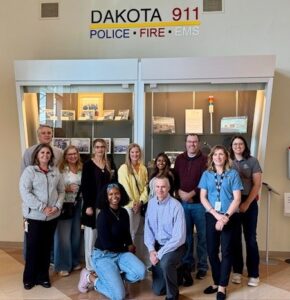 League of Minnesota Cities staff recently toured Dakota 911, the emergency communications and dispatch center serving Dakota County. Hosted by Executive Director Heidi Hieserich and Training Supervisor Rachel Keeler, the visit offered a behind-the-scenes look at the daily operations of one of Minnesota’s most advanced—and busiest—public safety support systems.
For cities across the state, Dakota 911 offers a powerful example of how regional collaboration, technology, and ongoing investment can enhance emergency response and community trust.
A Regional Model of Service
Dakota 911, formerly known as Dakota Communications Center, was established by a joint powers agreement in 2006 entered into by Dakota County and 11 cities located in the County. As a separate legal entity, Dakota 911 is governed by a joint powers board comprised of county and city officials. Dakota 911 receives its property/casualty coverage and workers’ compensation coverage through the League of Minnesota Cities Insurance Trust.
Behind the Numbers
In 2024, Dakota 911 averaged 800 calls a day and 70–100 calls per hour during peak periods, such as late afternoons and evenings. Their team of trained professionals works around the clock typically in 10- to 12-hour shifts to meet their benchmark of answering 95% of calls in 20 seconds or less.
But the volume and pace are only part of the story. The emotional labor is real—and often invisible. “You don’t know if you’re going to be good at this job until you pick up the phone,” Keeler said, highlighting the unpredictability and high-stakes nature of every call.
Challenges Shared by Cities
Staffing is one of the center’s biggest challenges, echoing issues many cities face in public safety roles. Recruitment often relies on word-of-mouth, and new hires must complete a nine-month training program before they’re ready to take calls. Burnout is common, as is difficulty handling “frequent flier” callers—residents who repeatedly contact 911 for non-emergency reasons, often due to untreated mental health needs.
City officials across Minnesota are familiar with these systemic challenges. What’s promising is that Dakota 911 isn’t standing still—they’re innovating to ease pressure on staff and improve service for residents.
Innovation That Benefits Cities
Several of Dakota 911’s recent and ongoing improvements are worth noting for any city considering how to enhance or modernize emergency response:
Non-emergency request line with multilingual accessibility
Live language translation tools in development
Improved mapping and live transcription of calls
AI attendants to help manage non-emergency calls
Public feedback surveys with early results showing a 97% satisfaction rate
Public education campaigns to help residents better understand when (and when not) to use 911
These changes not only improve the caller experience—they also support dispatcher well-being and resource efficiency, helping to ensure cities can continue delivering high-quality emergency response in the long term.
For city leaders, Dakota 911 is more than a dispatch center—it’s an example of smart, regional cooperation and proactive public safety management. Whether your community is facing staffing challenges, looking for ways to better serve residents with mental health needs, or exploring shared service models, there’s something to learn from Dakota 911’s approach.