

 or
or  lines to the right of the URL bar at the top of your browser
From D.C. to Olivia: Why Federal Workers Should Consider a Career in Local Government
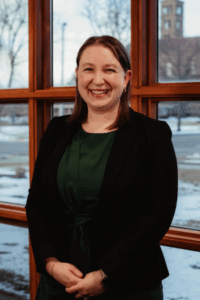 When Elizabeth Torkelson left her role at the Library of Congress to become the city administrator of Olivia, Minnesota, she traded the scale of federal government for the immediacy of local service, bringing her public sector experience to a community-focused role.
After serving as a congressional relations specialist for more than a decade in Washington, D.C., Torkelson took a leap that many federal workers may not initially consider: transitioning to local government. Her journey shows that local service isn’t a step down—it’s a step closer.
“Every time I visited Minnesota, I was really sad to leave,” she said. “I didn’t want to just do any job. I really loved my job at the Library of Congress—I wanted to love my next job too.”
A Personal Path to Public Impact
Torkelson’s road to D.C. began at the University of Minnesota Morris, where a strong alumni network helped connect her with an internship at the Library of Congress. That summer experience led to a full-time role shortly after graduation.
At the Library, she served as a bridge between the institution and lawmakers, translating priorities and responding to congressional inquiries. But even as she thrived in that role, the desire to return home grew stronger.
The catalyst? A dinner conversation with her uncle and parents.
“He was the one who kind of planted the seed,” Torkelson explained. “He asked my parents, ‘Has she considered local government?’ And I hadn’t.”
That suggestion led her to reconnect with a fellow Morris alum, Evan Vogel, city administrator of Cambridge.
“No joke, I probably hadn’t spoken to Evan on the phone in 10 years,” she said. “The more we talked, the more I got excited about the possibilities, and the more confident I felt that I had transferable skills. Maybe this could be another job I love and become passionate about.”
From Capitol Hill to City Hall
One of the biggest revelations in her transition was how much her federal experience prepared her for city government.
“At the Library, I had very shallow knowledge about a lot of things—but I knew how to connect the dots,” she said. “You don’t have to be the expert on everything. You just have to know enough to bring the right people to the table.”
That mindset proved essential as she dove into managing local utilities, city finances, and community engagement. But the biggest shift wasn’t just operational, it was personal.
“You see the impact of your decisions so much more directly,” she said. “You make a decision at a council meeting, and the next day someone asks you about it at daycare pickup.”
A Life Rooted in Community
Torkelson’s story isn’t just about a career pivot—it’s about building a life embedded in the community she serves. In Olivia, she wears jeans to work, juggles evening city meetings, and volunteers with the Lions and Kiwanis Clubs. Her kids are in local dance and swimming classes. She’s all in.
“I moved over a thousand miles from Rockville to Olivia. I wanted to live in the city I serve,” she said. “I truly love what I do. I didn’t know if I’d ever find something I’d be as passionate about as the Library of Congress. And I did.”
Why Local Government? Why Now?
Torkelson encourages federal workers—especially those facing uncertainty or burnout—to consider the switch.
“Most people in city government are more than willing to share their experience,” she said. “If you’re passionate about service, this is where you can make a difference.”
And that difference is tangible.
“We extended a trail recently, and no joke, as we were doing the final walkthrough, two people stopped us and said, ‘This is the best thing the city’s ever done.’”
For Torkelson, the meaning of public service has come full circle.
“I’m shaping the community my kids are growing up in,” she said. “It’s not just for them—it’s for the kids they go to school with, it’s every member here, and especially those residents who have been here their whole lives. They deserve to have a strong, thriving community. I’m really proud I get to be part of that legacy.”